
Provelopment Foundation — a reusable website foundation
Open source · Apache License 2.0
A real, working website base that a business or a developer starts from instead of an empty folder. You own your identity, content and branding; you reuse the parts that are expensive to rebuild every time.
Your business inputs
- Configuration
- Content
- Assets
Provelopment Foundation
Your website
Start where you are:
Start where you are
For businesses
A dependable website you own, deploy yourself, and can hand to any developer later.
- Your identity, content and branding stay yours.
- No account, subscription or platform lock-in.
- Change the business specifics without rewriting the system.
For developers
A disciplined starting point instead of an empty repository.
- Typed, validated configuration and content.
- Hexagonal boundaries, enforced by tests.
- A real validation gate from the first commit.
Implementers and agencies: the same base makes the second and tenth site cost far less than the first. You do not have to choose a commercial relationship to use Foundation — implement it yourself, use your own developer, or ask Provelopment for help.
Why Foundation exists
Every business website rebuilds the same fundamentals from nothing. Foundation moves that starting line forward.
Rebuilt website after website
- Routing, locales and page structure
- SEO metadata and structured data
- Responsive navigation and layout
- Forms, validation and contact seams
- A deployment and a quality gate
Foundation moves the starting line forward
- Those fundamentals already exist, tested
- Your business specifics are configuration and content
- The system stays a reusable base, not one site's code
- You deploy and own the result
How the model works
Four stages. Foundation owns the middle two; the first and last are yours.
Your business inputs
Configuration, content and branding — the parts that are specific to you.
Provelopment Foundation
The reusable system: routing, presentation, validation and integration seams.
Your website
One site, or several profiles, built from the same base.
Your deployment
Your own hosting account and your own domain.
Operational systems sit beside Foundation, not inside it
Foundation provides the seam and the configured destination. The service itself stays external, and you choose it.
Booking
An outbound link to whichever booking service you use.
Inquiry receiver
Forwarded to a webhook endpoint you control.
Maps
Directions resolved to your configured provider.
Analytics
Opt-in, and off unless you enable it.
Downstream systems
CRM, accounting and fulfilment stay yours.
What is included
The reusable pieces a business site needs. Each has a deeper explanation on Capabilities.
Identity and content
Business identity, page content, collections and media roles, all from configuration and files.
Presentation
A token-driven design system, layout primitives and a configurable navigation composition.
Internationalisation
Locale routing, per-locale content with fallback, and language selection.
Discovery
Canonical URLs, hreflang, sitemap, robots, Open Graph and structured data — all generated.
Connections
Contact, booking, maps and analytics as provider-neutral seams with explicit off states.
Engineering quality
Validated configuration, enforced boundaries, a real gate and browser verification.
Proven by real demos
Three live sites from one Foundation-derived system. They are demonstrations of reuse — not clients, and not case studies.
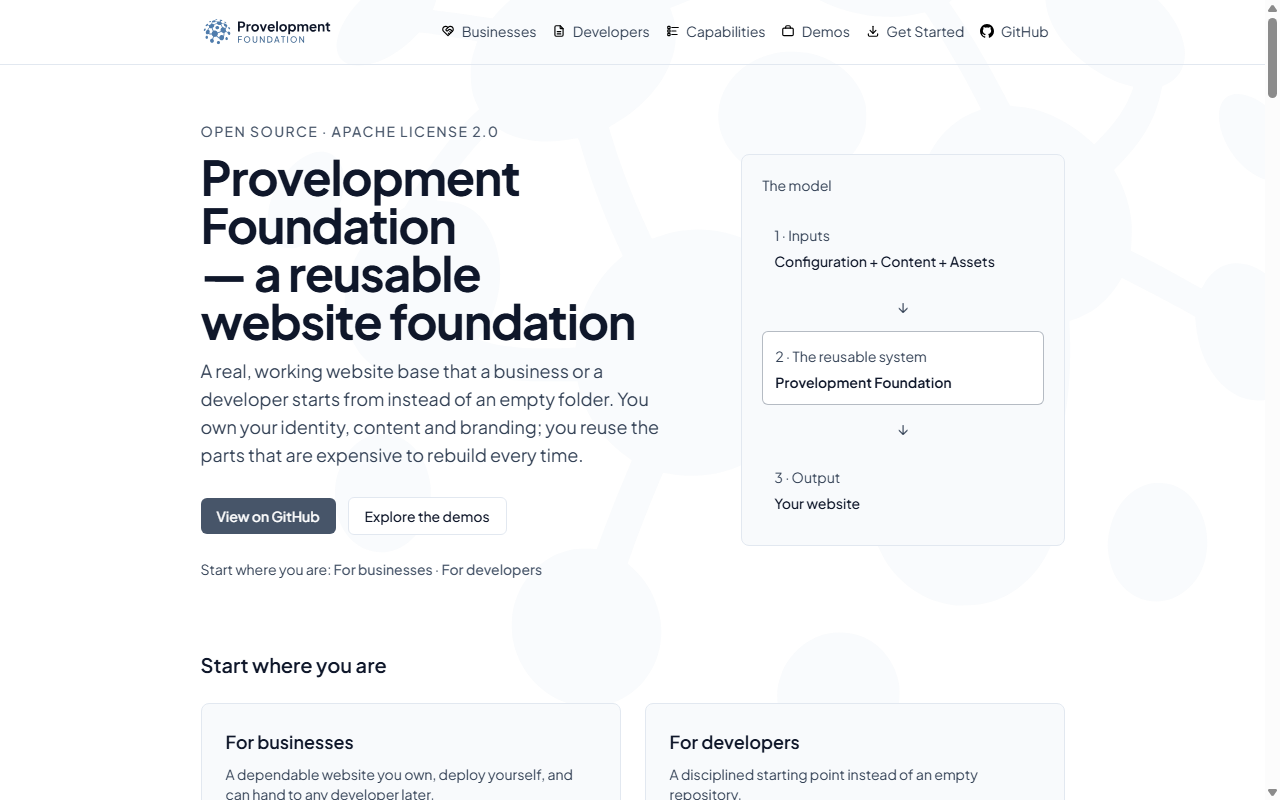
Open-source project site
This site: a project identity with its own information architecture and navigation composition.
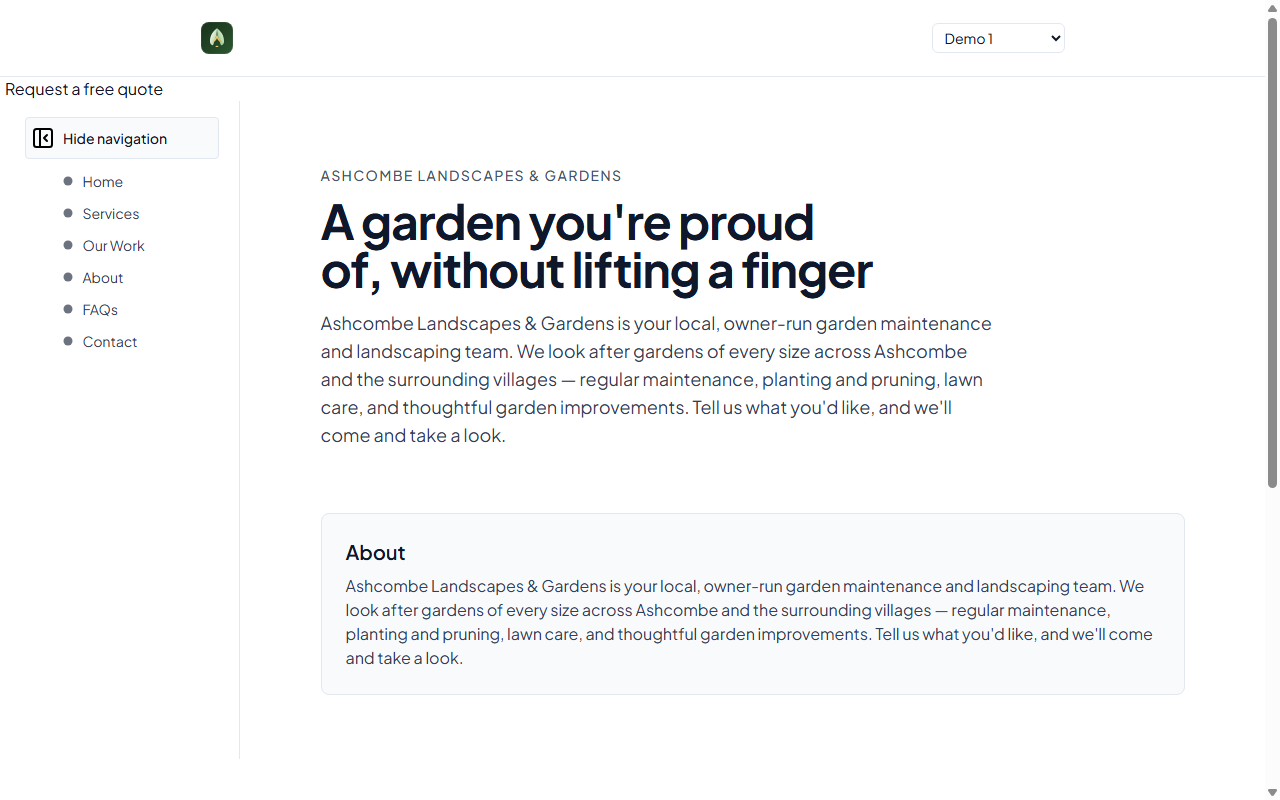
Service business with a portfolio
A different business type: local service pages, a project showcase and a quote-oriented path.
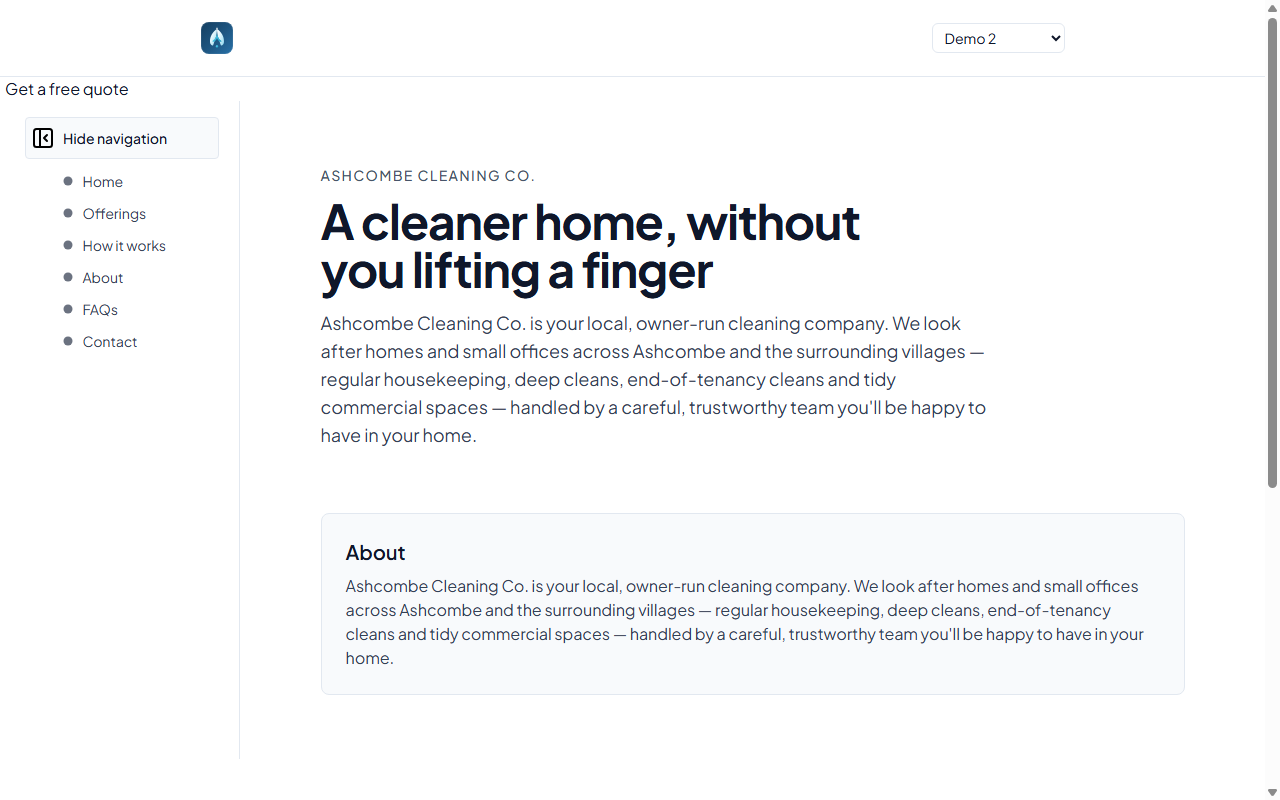
Recurring-service business
A different feature mix: fewer capabilities enabled, a simpler path and its own branding.
Shared
- The Foundation-derived runtime
- Routing and metadata machinery
- Presentation system and tokens
- Verification and gates
Different per site
- Identity and branding
- Content and navigation
- Enabled capabilities
- Feature choices
Engineering confidence
The project's claims are checkable in the repository rather than asserted in a brochure.
Validated configuration
One schema, strict about unknown keys, with actionable failures at build time.
Enforced architecture boundaries
Dependency direction and component purity are asserted by tests, not convention.
Real-browser verification
Responsive composition and interaction behaviour are driven in a real browser.
Accessibility-oriented engineering
Keyboard interaction, focus handling, semantic structure and computed contrast checks.
Automated gates
Assets, types, lint, tests and a production build run before a change lands.
Evidence-controlled claims
A capability cannot be claimed above the level its implementation and tests verify.
What this does not claim
Foundation does not claim WCAG conformance, published performance scores, universal browser or device coverage, or a security certification. Accessibility is engineered and verified, not certified; no penetration test has been performed.
Ownership and deliberate boundaries
Foundation is infrastructure you own, not a rented service. The split is deliberately obvious.
Yours
- Identity and site name
- Content and copy
- Dictionaries and locales
- Branding and assets
- Provider choices
- Deployment and domain
Foundation
- Reusable architecture
- Routing and content machinery
- Presentation system
- Configuration validation
- Integration seams
- Verification infrastructure
Foundation deliberately does not provide
- Authentication or customer accounts
- CRM or accounting
- Commerce or payment operations
- Operational scheduling
- A CMS or customer portal
- Managed hosting
These are architectural boundaries, not gaps: Foundation stops before operational complexity and provides the seam to whatever service you choose.
Get started
Eight steps from obtaining Foundation to a deployed site.
Get Foundation
Clone or fork the public repository.
Run locally
Install and start it to see the base working.
Configure
Set identity, locales and enabled capabilities.
Add content
Write your pages as content files.
Enable what you need
Turn on only the capabilities you want.
Connect services
Point the seams at your own providers.
Validate
Run the project's own gate.
Deploy
Deploy from your own account to your own domain.
Help without lock-in
Three legitimate routes. They are equally valid, and none of them is required.
Self-service
The repository and its documentation are complete enough to implement Foundation yourself.
Your developer or agency
Use whoever you already trust. The project is designed to be handed over without a dependency on its authors.
Provelopment
Optional implementation or support, if you want it. Foundation itself never requires a commercial relationship.
Build on Foundation
Read the code, run it, change it. It is yours to own.
- Explore the demos
- About the project